NFU Professor Chen Ta-Cheng Addresses New Governance Challenges of Generative AI with "AI Self-Optimizing Prompts"
2026-02-06
Admin System
Generative AI is rapidly permeating key sectors such as manufacturing, finance, education, and public governance. However, during the practical implementation process, businesses and organizations commonly encounter a critical yet underestimated bottleneck: AI's performance is highly dependent on how instructions are written by humans. Precisely written prompts yield impressive AI performance, while even slightly off-target prompts can produce bias, hallucination, or even affect the quality of decision-making. As generative AI gradually enters core operational and governance scenarios, Professor Chen Ta-Cheng states that how to reduce reliance on individual, experience-based "prompt engineering" has become a new issue of shared concern for both industry and policymakers. Research from National Formosa University is attempting to offer a breakthrough direction for this structural problem. The research project "Applying Immune Algorithms to Optimize Self-Referential Prompt Generation for Large Language Models," led by Professor and Vice President Chen Ta-Cheng of NFU's Department of Information Management, approaches the topic from the perspective of technology governance and practical usability, rethinking the core limitations facing large language models in industrial applications. Unlike mainstream research that continues to focus on the race for "bigger models, more computing power," Chen offers a key reflection: what truly limits the performance of large language models is often not the model itself, but how humans guide it to think. He points out that the current quality of generative AI usage still relies heavily on a small number of experienced prompt engineering professionals. This "hidden technical threshold" is not only difficult to scale, but also conflicts with the stable, controllable, and reproducible governance needs that businesses seek. If AI's behavioral performance must depend on individual skill over the long term, it will be difficult for it to become a trustworthy organizational tool. To address this issue, the research team introduced the concept of immune algorithms into the project, constructing an automated mechanism that allows AI to optimize its own prompt instructions. This method simulates the evolutionary logic of biological immune systems, allowing the large language model to repeatedly generate, test, compare, and eliminate multiple versions of instructions, gradually retaining the better-performing prompting methods while maintaining diversity in solutions, to avoid premature convergence on a single, potentially biased path. The entire optimization process is completed entirely by the same large language model on its own, without requiring additional training data or human intervention. The research shows that through this design of "AI self-optimizing prompts," the model's performance on tasks such as mathematical reasoning and common-sense judgment is significantly better than unoptimized original prompts, and also surpasses existing automated prompting methods and manually written instructions. In some test scenarios, the AI was able to consistently produce correct results, demonstrating that prompt quality has become a key variable affecting AI performance and trustworthiness. From the perspective of industry and technology governance, the significance of this research lies not only in improving AI performance, but also in reducing the uncertainty and human risk associated with AI adoption. When prompt optimization can be institutionalized and turned into a standard process, businesses can deploy generative AI more stably without relying on a small number of experts, further strengthening internal controls, accountability, and the explainability of decisions. Looking ahead, this type of technology is expected to be applied in areas such as smart manufacturing process optimization, educational assistance systems, enterprise decision support, and multi-agent automation systems, giving AI the ability to self-correct and continuously evolve over long-term operation, rather than remaining a one-time configured tool. This also offers a new way of thinking about the governance of generative AI: the "core of governance" lies not only in a model's capabilities, but in how to design mechanisms that ensure AI is "used correctly." Amid the global wave of competition in generative AI over computing power and model scale, research from National Formosa University points to another possible direction for industry and policymakers alike: rather than continuously making AI bigger, it may be more valuable to help AI better understand how to be asked the right questions, so that it can become a truly trustworthy and governable intelligent partner.
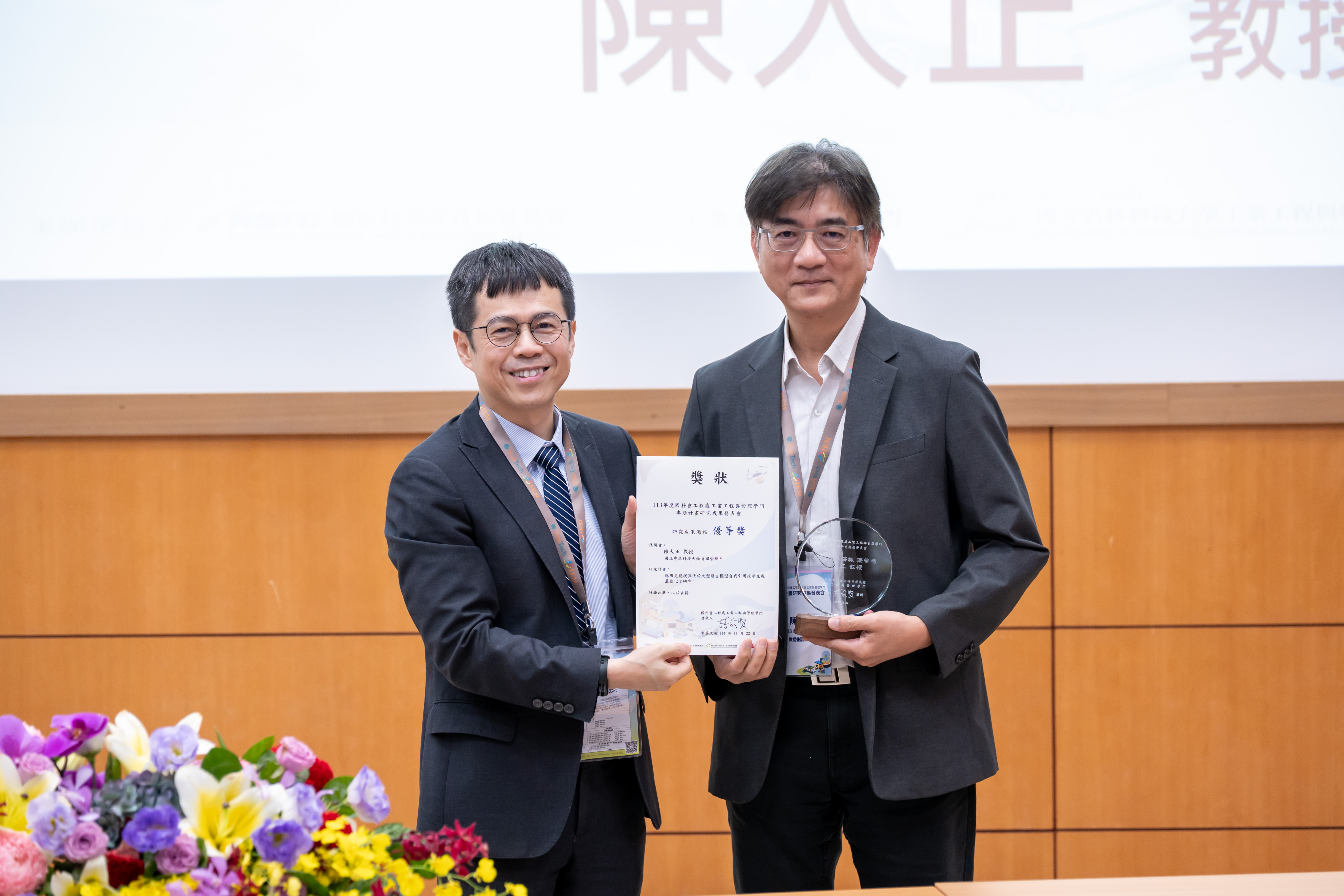
**Professor Chen Ta-Cheng (right), Vice President and Faculty Member of NFU's Department of Information Management, Receives an Excellence Award for a Research Poster in the Industrial Engineering Division from the National Science and Technology Council, for his research on AI self-optimizing prompts/instructions.**
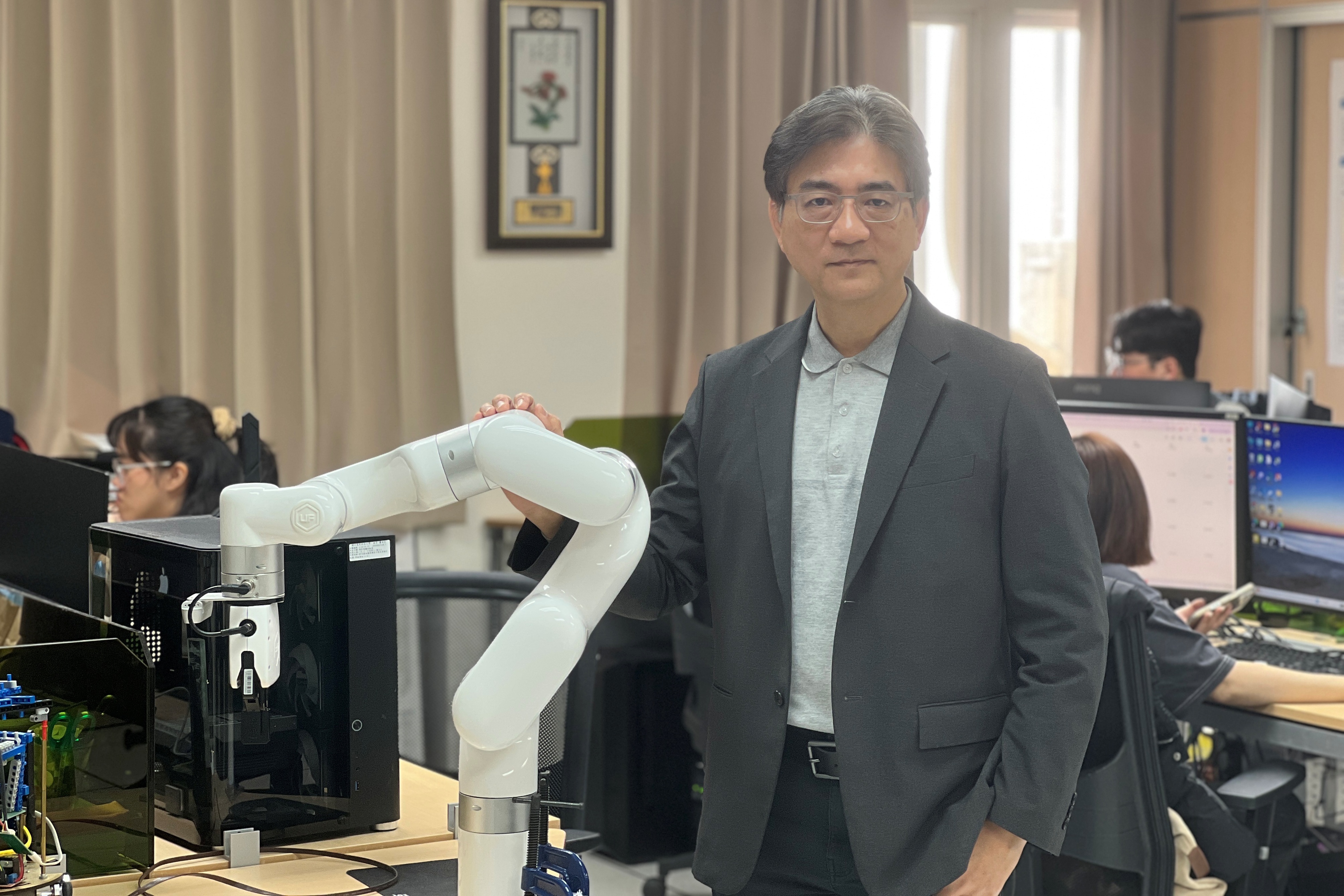
**NFU Department of Information Management Professor and Vice President Chen Ta-Cheng Addresses New Governance Challenges of Generative AI with "AI Self-Optimizing Prompts"**